
Russia has remained one of the largest destinations for imports and exports because of its abundant natural resources, large industrial base, agricultural production, energy infrastructure, and extensive geographic connectivity. International trade has continuously been playing an important role in supporting the energy, mining, metals, and agriculture sectors. Russia Import data have been serving as a valuable tool for commercial intelligence looking for the country’s changing trade structure.
Russia merchandise trade has been strongly influenced by energy commodities, particularly crude petroleum, refined petroleum, and natural gas. Fertilizers, cereals, machinery, chemicals, and agricultural products have been the main components of the country’s international trade. The redirection of Russian trade towards Middle Eastern, African, and emerging markets has become the most significant developmental factor influencing the import-export landscape.
THE SIGNIFICANT ROLE OF RUSSIA IN THE GLOBAL MARKETPLACE
Russia trade data reported that the country has established itself as a significant authority supporting different categories of supply, mainly because of the substantial reserves of crude oil, natural gas, coal, metals, fertilizers, and agricultural commodities. The export economy has been supporting the energy and natural resource industries. The import market is dependent on machinery, electric vehicles, pharmaceuticals, and consumer products. China is one of the top import trading partners, strengthening the bilateral commercial activity across energy, machinery, and electronics.
Turkey, Kazakhstan, Belarus, Armenia, and the United Arab Emirates are some of the top trading partners of the region. Russia customs shipment data reported the geographical restructuring of trade as the main factor encouraging Russian businesses to develop alternative logistic corridors. The Russia customs data and Russia shipments data have mainly become useful for seeking companies’ visibility into changing international purchasing.
THE COMPREHENSIVE OVERVIEW OF RUSSIA IMPORTS
Russia import data shows that the import requirements are mainly because of the demand for machinery, electrical equipment, vehicles, pharmaceuticals, and chemicals from the Russian consumer base. Russia import trade data represents the large domestic industrial base and international suppliers as the main factors supporting the country’s role as an important region providing advanced equipment and technology-related products. Machinery and mechanical equipment are some of the most important categories of the Russian import market. This specific sector has been supporting the manufacturing, construction, mining, energy, and transportation sectors. Electrical machinery and electronic equipment have promoted the trade of telecommunications, industrial automation, and information technology towards the top importing regions.
Passenger vehicles, commercial vehicles and associated equipment have also contributed to the international purchasing activity. Pharmaceuticals and medical products have maintained the importance of domestic healthcare requirements. China is an important resourcing authority for Russian traders because of machinery, electronics, automobiles, and industrial equipment supplied by the Chinese authorities. Russia trade data therefore reported the international suppliers as the main factor promoting the determination of products that are in consistent demand.
EXPORT MARKET OVERVIEW OF RUSSIA
Russia Export Data listed the strong dependence of the country on natural resources and commodity-based industries as a factor supporting the landscape of the statistical growth of the country’s supply. Crude petroleum, refined petroleum, natural gas, coal, gold, and fertilizers are the significant exported categories. Energy remains one of the strong beneficial factors that has been crafting Russia’s export economy. Crude petroleum is one of the most important export commodities.
China and India are also important destinations that shape the overall trade landscape. Natural gas is another strategic export commodity that drives the logistical growth rate of the Russian authorities. Russia shipment data listed changing geopolitical and commercial conditions as the main factor encouraging the greater emphasis on Asian markets. Coal plays an important role in Russian exports because of the thermal and metallurgical coal demand rate on the global consumer base.
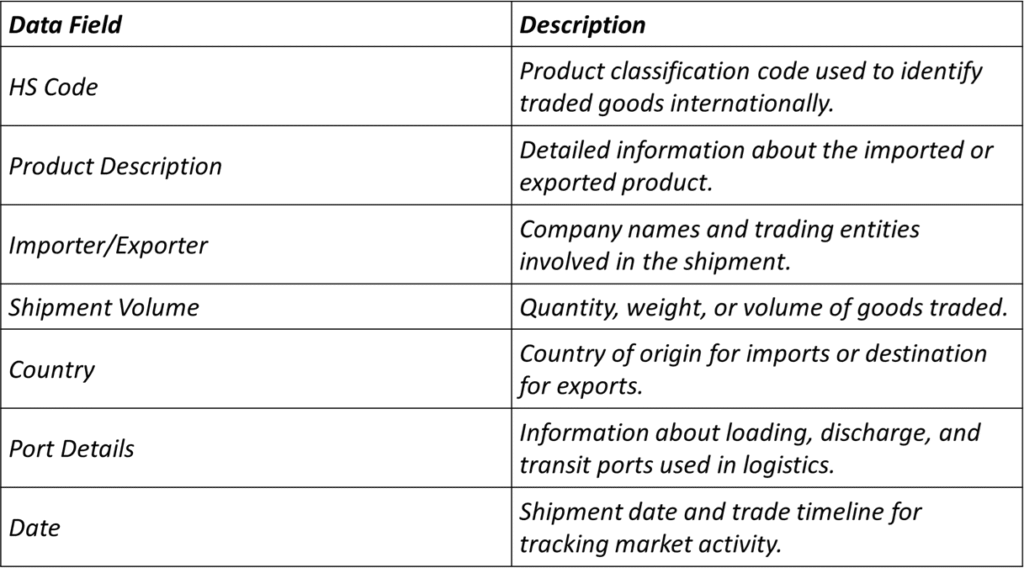
WHAT DETAILS ARE INCLUDED IN RUSSIA CUSTOMS DATA?
THE EFFECTIVENESS OF RUSSIA IMPORT-EXPORT DATA PROVIDERS IN BUSINESS GROWTH
Russia import-export data providers are a valuable tool that transforms trade information into commercial intelligence for businesses looking for service expansion. Businesses entering the Russian trade can properly examine the shipment patterns with identification of potential buyers and suppliers to acknowledge the latest demanded categories. Russia import data helps the authorities identify companies purchasing particular products from international markets.
The companies selling machinery and chemicals can analyse the purchasing activity to identify organizations with recurring requirements. The Russia shipment data and Russia trade data help the authorities with acknowledgement of competing suppliers. Businesses can evaluate the supply rate of similar products for alternative sourcing relationships. The trade intelligence supports sales and marketing strategies with a statistical approach towards the entire market.
HOW DOES RUSSIA IMPORT-EXPORT DATA SUPPORT BUSINESS GROWTH?
- Identification of global buyers and suppliers – Russia trade data gives a clearer visualization to the business authorities regarding importers, exporters, distributors, manufacturers, and wholesalers. It allows businesses to create more focused prospects with the identification of organizations.
- Analysis of competitor activities – Russia import data helps the authorities with analysis of competitor activities that support intelligence, creating marketing opportunities for the businesses. The authorities can even compare their international sourcing strategies for proper identification of alternative suppliers.
- Understanding market demand trends – The historical shipment data helps businesses evaluate changes in purchasing activity. The companies can monitor product demand along with an understanding of seasonal purchasing patterns. It supports better demand forecasting.
- Supply chain optimization – Russia customs data helps businesses clearly examine the geographical structure of the supply chain. The companies can identify alternative sourcing for evaluation of supplier concentration and development of strategies.
- Product and market identification – Russia customs data supports trade analysis while enabling businesses to examine specific product categories. It helps exporters prioritize the products and markets with stronger commercial potential.
FUTURE TRADE OUTLOOK OF RUSSIA
The future trade of Russia is strongly influenced by energy demand, commodity prices, the Asian market, agricultural production, and critical minerals. Energy will be an important component of Russia’s export economy, as reported by the Russia trade data. China and India are the top trading regions crafting the market landscape for Russian commodities.
Agricultural exports have provided opportunities for future trade growth. The large agricultural production and fertilizer industry have positioned the country as an important participant in the global marketplace. Digital trade intelligence is getting increasingly valuable mainly because of the complex international supply chains. Companies using the Russia customs data can stay updated with the latest trade insights.
CONCLUSION
Russia is a strategically important participant in the global marketplace because of its energy production, agricultural capacity, and mining industry. Russia export data continuously demonstrated the nation as the top supplier of crude petroleum, natural gas, and coal fertilizers. The Russia import data highlighted the resourcing of machinery, electrical equipment, and vehicles. The rise in the importance of China, India, and Turkey has represented Russia’s ranking as the transformation towards an international trade network.
CTA
Trying to expand your business in the Russian market? You have come up at the right platform here. Import Globals is designed and skilled in providing detailed information regarding distributors, buyers, suppliers, and manufacturers. Russia trade data from Import Globals strengthens your market research with proper analysis of sourcing strategies and business expansion decisions. Subscribe to www.importglobals.com or drop an email at info@importglobals.com for detailed information on the latest Russian trade activities to drive your global business growth.
FAQs
Que –Why is Russia export data beneficial for business growth?
Ans –Russia Export data helps businesses grow with proper identification of international buyers and supplier relationships.
Que –What are the top exported products of Russia?
Ans –Crude petroleum, refined petroleum products, and natural gas are the top exported products of Russia.
Que –How does Russia import-export data support business growth?
Ans -Russia import-export data support business growth via proper identification of buyers, supplier analysis, analysis of market demand, and development of effective market expansion strategies.
Que –What information is available in Russia trade data?
Ans -Russia trade data covers Importer names, Exporter names, Shipment date, HS Code, Product Details, quantity, values, pricing information, origin country, importing country & port details.
Que –How frequently is Russia trade data updated?
Ans -Russia trade data is updated on a monthly basis.
Que –Where can you get detailed information on Russia trade data?
Ans –Visit www.importglobals.com or drop an email at info@importglobals.com for detailed updates on Russia trade data.