
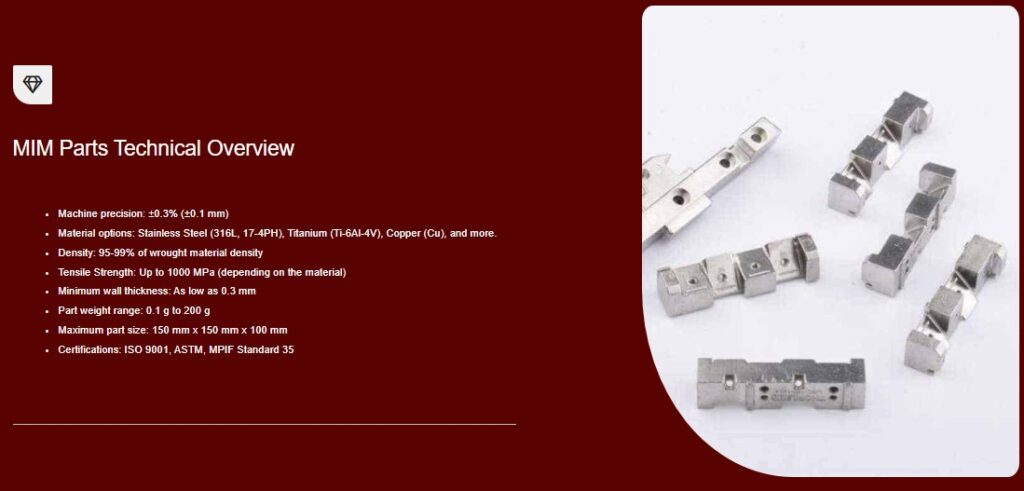
When it comes to manufacturing precision metal components, engineers and designers often face a critical decision: should they opt for MIM parts or stick with traditional machining methods? Both approaches have their advantages and limitations, and choosing the right method can significantly impact product performance, production costs, and lead times. This article explores the differences between MIM parts and traditional machining to help manufacturers make informed decisions.
Understanding MIM Parts
Metal Injection Molding (MIM) is a process that combines the flexibility of plastic injection molding with the strength and durability of metal. In MIM, fine metal powders are mixed with a binder material to create a feedstock, which is then injected into molds to form complex shapes. After molding, the parts go through a debinding process to remove the binder, followed by sintering to fuse the metal particles into a solid component.
One of the primary advantages of MIM parts is their ability to produce highly intricate geometries that would be difficult or impossible to achieve with traditional machining. Components with fine features, thin walls, or internal channels can be produced with high precision. MIM also allows for high-volume production, making it ideal for industries such as medical devices, automotive, and aerospace.
Key Features of Traditional Machining
Traditional machining involves removing material from a solid metal block to achieve the desired shape. Processes such as milling, turning, drilling, and grinding are commonly used in machining. Unlike MIM parts, which are shaped from powdered metal, machined components are created by cutting away excess material.
Machining is highly versatile and can work with a wide variety of metals, including stainless steel, titanium, aluminum, and brass. It allows for precise tolerances, surface finishes, and adjustments even during production. For low-volume production or prototypes, traditional machining is often preferred because it does not require expensive molds or lengthy setup processes.
Comparing Cost Efficiency
Cost is often a decisive factor when choosing between MIM parts and traditional machining. MIM can reduce costs for large production runs because it produces near-net-shape components with minimal post-processing. While the initial investment in tooling and mold creation is higher, the per-unit cost decreases significantly as production volume increases.
In contrast, traditional machining can be more cost-effective for small production runs or custom components. Machining does not require specialized molds, and setup times are generally shorter. However, machining generates more material waste, and the labor and machine time required for complex shapes can increase costs dramatically for large batches.
Complexity and Design Flexibility
One of the standout advantages of MIM parts is their design flexibility. MIM can produce intricate designs with undercuts, fine threads, and internal cavities that would be challenging or impossible with traditional machining. This capability enables engineers to consolidate multiple parts into a single component, reducing assembly requirements and potential points of failure.
Traditional machining, while highly precise, has limitations when it comes to complex geometries. Features like deep pockets, intricate internal channels, or extremely thin walls often require multiple operations, special tooling, or even additional assembly steps. For applications where complex shapes are essential, MIM parts offer a clear advantage.
Material Options and Mechanical Properties
MIM parts are typically made from stainless steel, titanium, cobalt-chrome, or other high-performance alloys. The sintering process gives these components excellent mechanical properties, including high strength, wear resistance, and corrosion resistance. However, MIM parts may have slightly lower density compared to wrought materials, which could affect applications requiring maximum fatigue resistance.
Traditional machining offers unmatched material flexibility and the ability to use wrought metals with superior mechanical properties. Machined components often have higher density, better fatigue performance, and predictable material characteristics. For applications requiring extreme strength or specialized metal grades, machining may be the preferred choice.
Production Speed and Lead Time
Lead time can significantly impact a project’s success. MIM parts require upfront investment in mold creation and feedstock preparation, which can extend initial lead times. However, once the molds are ready, MIM allows for rapid production of large quantities of parts with consistent quality.
Machining, on the other hand, can start production almost immediately, making it ideal for prototyping and low-volume manufacturing. Changes in design are easier to implement since modifications only require adjustments in the machining program, rather than new molds. For fast-turnaround projects, traditional machining often has the edge.
Surface Finish and Post-Processing
MIM parts usually achieve excellent surface finishes directly from the mold, reducing the need for extensive post-processing. They can also be heat-treated or plated to enhance hardness, corrosion resistance, or aesthetic appeal. However, certain high-precision applications may require additional finishing to meet exact tolerances.
Machined parts can achieve extremely tight tolerances and smooth finishes, especially when processes like grinding or lapping are used. The precision achievable in traditional machining is often superior for applications requiring critical fits or extremely fine surface finishes.
Applications and Industry Considerations
MIM parts are widely used in industries that demand complex shapes and high-volume production. Examples include surgical instruments, dental components, automotive gears, and consumer electronics. The process is especially advantageous when multiple small parts can be consolidated into one complex component, reducing assembly time and cost.
Traditional machining dominates applications that require specialized metals, low volumes, or extremely high precision. Aerospace components, heavy machinery parts, and prototypes often rely on machined components due to the material properties and tight tolerances that machining can provide.
Sustainability and Material Efficiency
Sustainability is becoming increasingly important in manufacturing. MIM parts are generally more material-efficient than traditional machining, as the near-net-shape process minimizes waste. Most of the unused powder can be recycled for future production, making the process more environmentally friendly.
Traditional machining, by contrast, can produce significant amounts of scrap metal, especially for complex shapes. While recycling is possible, the energy and effort involved in recovering scrap material can reduce overall efficiency. For manufacturers focused on minimizing waste, MIM offers a greener alternative.
Making the Right Choice
The choice between MIM parts and traditional machining ultimately depends on several factors: production volume, part complexity, material requirements, cost constraints, and lead time. MIM is ideal for high-volume production of complex components with intricate geometries and minimal post-processing. Traditional machining remains the preferred choice for low-volume, high-precision components, or when specialized materials are required.
Many companies adopt a hybrid approach, using MIM for components that benefit from design complexity and volume production, while reserving machining for critical features or materials with specific mechanical properties. Understanding the strengths and limitations of each method ensures that manufacturers select the most efficient and cost-effective process for their specific needs.
Conclusion
Both MIM parts and traditional machining have unique advantages, and neither method is universally better. MIM offers unmatched design flexibility, high-volume cost efficiency, and material conservation, making it ideal for complex components. Traditional machining provides versatility, high precision, and superior material properties, making it suitable for prototypes, specialized alloys, and low-volume production.
By carefully evaluating production needs, part geometry, material selection, and budget, manufacturers can determine the best approach for their projects. In many cases, combining both methods strategically can optimize performance, cost, and efficiency, giving companies a competitive edge in today’s demanding manufacturing landscape