
Table of Contents
- The Unseen Revolution – Understanding Solution Dyed Polyester
- Market Landscape: China’s Dominance and Supply Chain Structure
- Technical Advantages and Performance Data: Why Choose Solution Dyed?
- A Buyer’s Guide to Key Specifications and Quality Tiers
- The Wholesale Ecosystem: Navigating Factories, Trading Companies, and MOQs
- Strategic Sourcing: Cost Analysis, Negotiation, and Risk Management
- Application Spotlight: Maximizing Value Across Industries
- The Future: Sustainability and Innovation in Solution Dyeing
- Building a Competitive Advantage with Chinese Supply
- Frequently Asked Questions (FAQ)
1. The Unseen Revolution – Understanding Solution Dyed Polyester
For international buyers in textiles, the term “dyed yarn” often conjures images of vast, water-intensive dyeing baths. However, Wholesale of China’s Solution Dyed Polyester Filament Yarn: A Sourcing Guide for Global Buyers a transformative technology has been reshaping supply chains from the very first step: solution dyed polyester filament yarn. Unlike conventional methods where white yarn is dyed after spinning or weaving, solution dyeing (also known as dope dyeing or spun dyeing) incorporates pigment or colorant directly into the polymer melt before the filament is extruded. The result is not just a colored yarn, but a fundamentally superior product with unparalleled color fastness and environmental benefits. China has emerged as the world’s undisputed leader in the production and wholesale of this innovative material, offering global procurement managers a unique opportunity to enhance product quality, streamline logistics, and meet stringent sustainability targets.
This guide is designed for the discerning buyer. We will move beyond basic descriptions to provide a technical, commercial, and strategic roadmap for sourcing solution dyed polyester filament yarn from China, empowering you to make informed decisions that impact your bottom line and product integrity.
2. Market Landscape: China’s Dominance and Supply Chain Structure
China’s command of the global polyester value chain, from PTA and MEG production to advanced spinning, has naturally extended to solution dyed filaments. It is estimated that China accounts for over 80% of global production capacity for this specialty yarn. The market is concentrated in major industrial clusters:
- Zhejiang & Jiangsu Provinces: The epicenter of high-quality filament production, home to technologically advanced, large-scale spinners like GLYarn and Xinghui Group. This region focuses on premium, consistent yarns for apparel and technical textiles.
- Fujian Province: A powerhouse for textile manufacturing, with a strong focus on volume and value, supplying a broad range of standard solution dyed yarns.
- Guangdong Province: Known for flexibility and rapid response, with many mills catering to fast-fashion and accessory markets.
The wholesale channel is bifurcated:
- Direct from Major Spinning Mills: For large-volume buyers (typical MOQ > 5-10 tons per color), engaging directly with integrated manufacturers offers the best pricing, technical support, and traceability. These mills often have in-house polymer and masterbatch production.
- Through Specialized Trading Companies: For smaller volumes or buyers needing a palette of colors without hitting individual MOQs, reputable traders aggregate demand. They provide crucial services like QC, logistics consolidation, and color matching but at a 5-15% price premium.
3. Technical Advantages and Performance Data: Why Choose Solution Dyed?
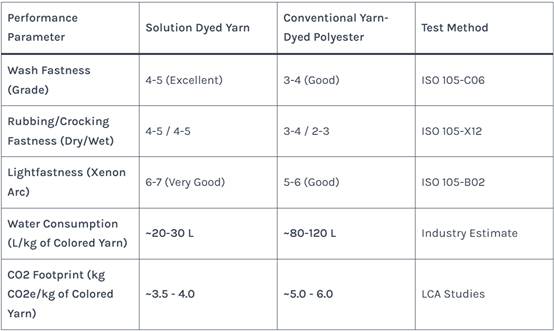
The superiority of solution dyed yarn is quantifiable. Its performance stems from the fact that the color is locked within the molecular structure of the fiber.
- Exceptional Color Fastness: Because the pigment is integral to the fiber, it cannot wash out or be rubbed off easily. It dramatically outperforms conventionally dyed yarns.
- Enhanced Lightfastness: The color is resistant to UV degradation, a critical factor for automotive interiors, outdoor furniture, and curtains.
- Superior Ecological Profile: The process eliminates the post-yarn dyeing stage, saving approximately 50-60% of water and reducing energy consumption by about 30-40%. It also completely avoids the discharge of dyehouse effluent, aligning with ZDHC and other environmental standards.
Table 1: Performance Comparison: Solution Dyed vs. Conventional Yarn-Dyed Polyester
4. A Buyer’s Guide to Key Specifications and Quality Tiers
Not all solution dyed yarn is created equal. Savvy buyers must specify beyond just color and denier.
- Core Specifications:
- Denier & Filament Count (e.g., 75D/72F): Determines yarn fineness, hand feel, and fabric density.
- Cross-Section: Round (standard), trilobal (for sparkle), hollow (for insulation).
- Luster: Bright, semi-dull, full-dull.
- Tenacity & Elongation: Critical for high-stress applications like seat belts or industrial sewing threads.
- The Color Masterbatch: The quality of the colorant is paramount. Inorganic pigments offer the best fastness but a limited color range. Organic pigments provide vibrant colors but may have slightly lower lightfastness. High-tier mills use premium, heat-stable masterbatches to ensure consistency during high-temperature processing.
- Quality Tiers:
- Premium Grade: From top-tier mills. Exceptional evenness, minimal defects, certified masterbatches, full traceability. Used for automotive, premium apparel, and brand-centric products. USTER® statistics are commonly provided.
- Standard Grade: Good commercial quality for most apparel, home textiles, and toys. Reliable performance but may have slightly higher tolerance for imperfections.
- Economy Grade: Often from smaller mills, suitable for low-cost applications like basic bags or secondary lining where ultimate fastness is less critical.
5. The Wholesale Ecosystem: Navigating Factories, Trading Companies, and MOQs
Understanding the wholesale landscape is key to finding the right partner.
- Minimum Order Quantities (MOQs): This is the single biggest differentiator.
- Direct Mills: 5 to 20 metric tons per color is standard for custom colors. Stock colors may have lower MOQs (1-3 tons).
- Trading Companies: Can offer MOQs as low as 500 kg to 1 ton per color, as they hold stock or combine orders from multiple clients.
- Lead Times:
- Stock Colors: 2-4 weeks for production and shipping.
- Custom Colors: 6-10 weeks, including masterbatch formulation, sample approval, and production.
- The Role of Sourcing Agents: For first-time buyers or those without a dedicated China office, a reputable sourcing agent is invaluable. They handle supplier verification, factory audits, QC inspections, and logistics, typically for a fee of 3-8% of the order value.
6. Strategic Sourcing: Cost Analysis, Negotiation, and Risk Management
- Cost Drivers: The price is not just the yarn. It’s a function of:
- Raw Materials: PET chip price + cost of specialized masterbatch.
- Spinning Complexity: Fine denier, special cross-sections, and high tenacity add cost.
- Color: Standard blacks and navies are cheapest. Vibrant or custom colors are more expensive.
- Order Volume & Relationship: Long-term contracts secure better pricing.
- Price Benchmark: As a reference, wholesale FOB prices for standard 75D/36F solution dyed DTY in a basic color might range from $1.80 to $2.50 per kg, depending on grade and supplier type. Premium grades can be 15-30% higher.
- Risk Mitigation:
- Always Request Physical Skein Samples before bulk production.
- Insist on Third-Party Testing for color fastness and physical properties against agreed specs.
- Use Secure Payment Terms: A combination of T/T (30% deposit, 70% against BL copy) is standard. Consider Letters of Credit for new, unverified suppliers.
- Visit the Factory or Hire an Auditor: For orders above a certain threshold, a pre-production audit is a wise investment.
7. Application Spotlight: Maximizing Value Across Industries
- Apparel & Sportswear: For performance wear where sweat resistance is key, and for uniform programs requiring absolute color consistency over thousands of garments and many washes.
- Home Textiles & Upholstery: The go-to choice for curtains, sofa fabrics, and outdoor cushions where sunlight resistance is non-negotiable.
- Automotive Interiors: Mandatory for seat belts, seat covers, and interior trim due to extreme lightfastness and low fogging requirements.
- Technical Textiles: Used in awnings, tents, and geotextiles where longevity under environmental stress is paramount.
- Accessories & Footwear: For bags, shoes, and labels where color bleed or rub-off would be a critical failure.
8. The Future: Sustainability and Innovation in Solution Dyeing
The trajectory is clear: solution dyeing is at the heart of a more sustainable textile industry. Innovations are focusing on:
- Bio-based and Recycled Feedstock: Combining solution dyeing with rPET (recycled polyester) or bio-PET to create a doubly sustainable product.
- Digital Color Matching & Inventory: Advanced systems to reduce sample lead times and allow for “color-on-demand” with lower MOQs.
- Functional Integration: Incorporating additives for anti-microbial, UV-blocking, or flame-retardant properties directly into the dope, creating multifunctional fibers in a single step.
9. Building a Competitive Advantage with Chinese Supply
Sourcing solution dyed polyester filament yarn from China is not merely a purchasing decision; it is a strategic investment in product durability, supply chain efficiency, and environmental stewardship. By understanding the technical nuances, navigating the wholesale structure with clear specifications, and partnering with the right tier of supplier, global buyers can unlock significant value. This material allows you to offer products that last longer, look better, and tell a compelling sustainability story—all while leveraging the scale, expertise, and competitive pricing of the world’s most advanced polyester industry.
10. Frequently Asked Questions (FAQ)
Q1: Is solution dyed yarn more expensive than yarn that will be dyed later?
A: The initial cost per kilogram is typically 10-20% higher than raw white yarn. However, this is a narrow view. The total cost of ownership is often lower when you factor in the elimination of dyeing costs, reduced risk of dye-lot variations, zero water treatment costs, and superior quality leading to fewer customer returns. For many applications, it is cost-neutral or even saving.
Q2: How limited is the color range? Can I match specific Pantone colors?
A: The range has expanded dramatically. While stock colors are most economical, top-tier Chinese mills have advanced labs capable of matching most Pantone colors. Expect a development fee and a higher MOQ for custom matches. The most challenging colors are very bright fluorescents and certain deep reds.
Q3: What about color consistency between batches?
A: This is one of its greatest strengths. Because the color is added at the polymer stage in a highly controlled, automated process, batch-to-batch consistency is exceptional and far superior to conventional piece dyeing, where many variables can affect the outcome.
Q4: Can solution dyed yarn be used for heather or mélange effects?
A: Yes, absolutely. This is a major application. By spinning filaments of two or more different solution-dyed colors together (e.g., black and white to make grey heather), you achieve a mélange yarn with unmatched color fastness. The heather effect will not wash out or fade differentially.
Q5: How do I verify the environmental claims of a supplier?
A: Ask for specific documentation. Reputable mills can provide:
* Life Cycle Assessment (LCA) data comparing their process to conventional dyeing.
* GRS (Global Recycled Standard) or RCS (Recycled Claim Standard) certification if using recycled content.
* Documentation of water and energy savings per ton of yarn produced.
Q6: Are there any drawbacks or limitations?
A: The primary limitations are:
1. Higher MOQs for custom colors compared to buying white yarn.
2. Longer lead times for new color development.
3. Inability to easily change color in mid-production run, which requires more precise forecasting.
Q7: What is the difference between “solution dyed” and “mass-colored”?
A: They are generally synonymous in the industry. “Solution dyed” is the more technically precise term, while “mass-colored,” “dope dyed,” or “spun dyed” are also commonly used.
Q8: Is it suitable for blends with other fibers like cotton?
A: Yes, but the fastness advantages apply only to the polyester component. When woven or knitted with cotton, the resulting fabric will have the excellent fastness of the polyester threads but the cotton will still need to be dyed conventionally if color is required.